
About
In the case of analogue photography, called “silver” photography, printing is the operation that consists of reproducing a negative image, the matrix, as a positive photograph. A ‘digital’ print, on the other hand, is obtained by a series of electronic processes, from shooting to printing.
The term ‘print’, which originates from the world of printmaking, also refers to the total number of positive photographs produced by a photographer during a single session of enlarging a negative.
In a photographer’s work, there are several types of prints, each corresponding to a specific production context or purpose. Each generation of prints carries a specific value within the history and market of photography. Thus, a photographer may produce several versions of the same negative at different stages of his career. At the time of shooting, they may produce a ‘vintage print’, which reflects their original creative intention. They may then produce a print for the press, which will have different formal characteristics to suit reproduction in newspapers; finally, they may produce a run of ten signed and numbered copies, plus two artist’s proofs, to sell to collectors, using a different format and process.
However, a shift in meaning has appeared in French over the last few years, with the term ‘print’(tirage) now being used as a synonym for a photograph or photographic print. This neologism, which emerged at the end of the 20th century through a process of metonymy, is now widely accepted as a term of professional slang by a section of the specialist community.
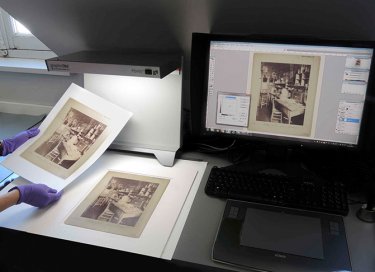
Reproduction of a print on albumen paper by the ARCP's Visual documentation and reproduction unit.
Contact Printing
In the case of analog photography, a contact print has the same dimensions as the negative. It was particularly favoured in the 19th century for printing-out techniques that are not sensitive enough to obtain a high-quality enlargement. This technique of printing was still practised along the 20th century to obtain contact sheets (studio proofs) allowing the photographer to choose the image to be printed.
Enlarging
The enlarged print produces a photograph larger than the matrix (negative). Made possible from the 19th century onwards with the emergence of solar enlargers, this technique became, however, widely used from the 20th century onwards, with the advent of much more sensitive gelatin-silver bromide emulsion, and the electric light.
Original Print
An original’ print refers to a definitive print from the original negative made by the photographer himself or under his direct supervision, from an original negative. We distinguish two types of original prints depending on when it was produced: vintage prints and late prints.
Vintage Print
A vintage print is an original print produced at a date close to when the photograph was taken. It is generally accepted that it is the original print that embodies the artist’s original creative
Late Print
A late print is an original print produced a long time after the date when the picture was taken. It is unlikely to be identical to the original print, as the artist’s intention may change, as may the materials and production tools available.
Reprint
A reprint is a print made from the original negative, beyond the author's supervision.
Duplicate
A duplicate is a copy of a negative or positive produced using the same gradation and contrast settings.
Fac-Simile
A facsimile print is a duplicate made according to the original process and format, in order to replicate the original’s aesthetic as closely as possible
Work Print
A work print is made to choose the different characteristics desired for the definitive print.
Collector's Print
The print in this case is produced with particular care, notably through very carefully controlled fixing and washing processes to prevent any chemical contamination, and with a protective toning treatment designed to protect the silver from oxidation. These collector’s prints are signed and numbered.
Exhibition Print
These prints produce original prints intended for exhibition. The print is returned to the artist or destroyed at the end of the exhibition.
Edition Print
Large-scale prints obtained by photomechanical process, under the photographer's supervision.
Press Print
Physical print intended to be reproduced in a printed document, such as a magazine or newspaper. Press prints have different aesthetic characteristics to collector’s proofs, as their photomechanical printing process increases the contrast of the image. Press prints therefore always have particularly smooth grey tones.
Glossary

Albumen Print

Aristotype

Autochrome

Carbon Print

Chromogenic Prints

Collodion Glass Plate Negative

Portrait Crayon

Cyanotype