
About
Oil Print Processes or Leotype
The technological principle behind this family of photomechanical processes is based on the repulsion between hydrophobic ink and water, the ink being applied to the surface of a gelatin matrix, which is saturated with varying amounts of water depending on the image values.
Historical period of production and use
The late 19th century saw the emergence of the “pictorialist” movement in photography, in which photographers with artistic ambitions sought to distinguish themselves from the nascent industrial photography (e.g. Kodak). These photographers emphasized effects, personal interpretation, and the photographer’s manual intervention in the creation of their images. Among the artisanal photographic processes associated with this movement, oil-based ink
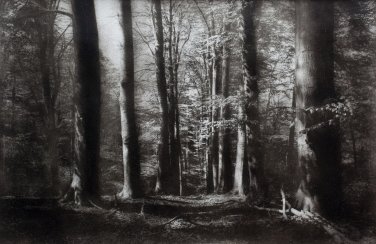
Untitled, Bromoil print on Baryta paper © Constance Asseman, 2015
Oil print processes or Leotype
The principle of oil printing was described by Alphonse Poitevin in 1855. The process was improved by G.E. Rawlins in 1904.
To make an oil print, gelatin is applied to a sheet of paper then sensitized using a solution of potassium bichromate. When exposed to light through a negative, the gelatin on the paper reacts with the bichromate and is hardened in proportion to the amount of light it receives. This print is then soaked in an aqueous solution and absorbs water. The dense (or dark) areas of the image are hydrophobic, absorbing little, whereas the areas that are less dense (highlights) are hydrophilic, soaking up water; a slight relief or embossed effect can be observed on the surface of the image. The paper sheet is then inked with a brush, a brayer or a combination of the two. The areas that are saturated with water repel the greasy ink while the drier areas accept it. This stage of making the print is a long and delicate process that sometimes involves several layers of ink and requires great dexterity. Because of the freedom of gesture allowed in applying the ink, the image can be interpreted by varying the treatment of different areas.
The bromoil process or eleobrom
The process was introduced in England in 1907 by E.J. Wall and was described as an alternative simpler to make. The composition of the term “bromoil” illustrates the hybrid nature of this type of print: “brom” refers to the gelatin-bromide base used, while “oil” refers to the greasy ink applied with a brush or a roller to create a visible image.
A sheet of gelatin-silver bromide paper is exposed under a negative through an enlarger. It is then subjected to a bleaching bath in which the gelatin of the photographic paper is tanned (hardened) in proportion to the density of the silver image — this image being “eliminated” in the same bath. The subsequent steps are the same as those of the creation of an oil print (oleotype).
Transfer techniques and commercialization
Starting in 1911, Robert Demachy suggested the possibility of transferring oil prints onto Fine Art or Japanese papers using a lithography press. This became an important practice in oil printing. Despite its manual nature, oil printing gave rise to commercial products: inks and stag foot–shaped fitch brushes, sold by James A. Sinclair & Co. of London, and special gelatin silver bromide papers, sold by Wellington, Ilford and Kodak. These products disappeared from supply catalogues in the 1950s, with the decline of the process.
Identification
The resulting photographs have a lithographic-like grain.
Deterioration
Oil-based ink is very stable, but the paper may oxidise, yellow and become brittle as it ages.
Credits
Visual Glossary of Photographic Processes © ARCP / Mairie de Paris, 2018
Glossary

Albumen Print

Aristotype

Autochrome

Carbon Print

Chromogenic Prints

Collodion Glass Plate Negative

Portrait Crayon

Cyanotype