
About
Mounting Large-Format Contemporary Photographs
One of the characteristics of contemporary photography is the frequent use of large formats. The exhibition, and necessary mounting of these large photographs raises technical issues related to ensuring that the image remains flat, isn’t too heavy to handle and doesn’t get damaged easily. Matting -the traditional way of presenting photographs -is useless for formats over 80 x 120 cm, either from a practical or an aesthetic perspective.
One efficient solution is to laminate the image on a flat, light, rigid support. The most common choices are aluminium, polymethyl methacrylate or PMMA (Plexiglas®), expanded polyvinyl chloride or PVC (like Forex®), a composite panel made of aluminium and polyethylene (like Dibond®) or a composite panel of aluminium and polyurethane (like Kapafix®). The image is laminated in a qualified workshop using a double-sided acrylic
adhesive. A drawback of this type of presentation is that it is not reversible.
Different hanging systems can be used: the image can be framed (under glass or not, in a shadow box, etc.) or a frame-like structure can be mounted on the back of the panel. The latter option is often preferred because it makes the mounting system almost invisible.
The English term “face-mounting” describes photographs mounted under the Diasec® license and those mounted using a similar process without a license.
The standard frame consists of strips with profiles that cover the edges of the artwork. It includes a protective glass panel. The strips of the shadow box do not cover the artwork. A gap of a few centimetres is left between the edges of the frame and the artwork, which is mounted on a rigid, flat backing.
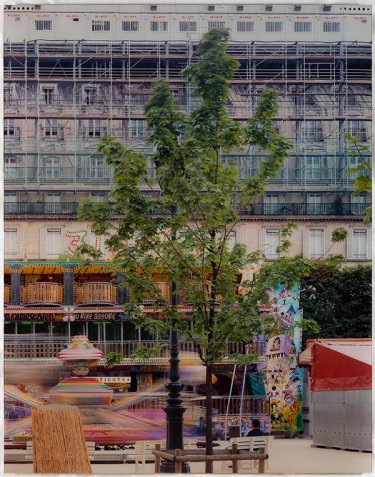
© Stéphane Couturier (né en 1957), « Jardin des Tuileries - Paris 1 – 1998 » 1998, 1/5, Epreuve couleur à destruction de colorants (Cibachrome/Ilfochrome) sous Diasec contrecollé sur aluminium, 160 x 125 cm, Fonds municipal d’art contemporain de la Ville de Paris (FAC). © Stéphane Couturier / FAC / Roger-Viollet
Diasec® mounting
Diasec® is a commercial mounting process with a specific appearance. It was patented in Switzerland in 1972, and ever since its use has required a license agreement. It involves bonding the image side of a photograph to a transparent protective sheet. In addition, the back of the image can be protected by lamination on another surface, as described above. Bonding the image side of the photograph has an aesthetic impact on the work, increasing its contrast and its colour saturation, like a varnish. The effect is emphasized by the shining aspect of the PMMA (although matt material can also be used, becoming then translucid).
The Diasec® patent covers the bonding process, which uses a silicone-based primer. The translucent panel usually employed is PMMA, which is inexpensive and easy to handle, has excellent optical characteristics and can incorporate a UV inhibitor and anti-reflective treatment. It is also relatively light and very impact resistant. The PMMA becomes the surface of the artwork because the bonding process is irreversible.
Except for rare adhesion problems (localized lifting) conservation issues are usually mechanical, especially due to the fact that PMMA is very sensitive to abrasion.
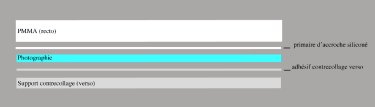
Schéma Diasec © ARCP / Mairie de Paris, 2017
Credits
Visual Glossary of Photographic Processes © ARCP / Mairie de Paris, 2023
Glossary

Albumen Print

Aristotype

Autochrome

Carbon Print

Chromogenic Prints

Collodion Glass Plate Negative

Portrait Crayon

Cyanotype